
32 Things I Know
#54: Hardwon lessons I'm happy to have learned at 32

Hello!
Amidst these heartbreaking gas prices, the harrowing news, and the helplessness of just watching it all, here is my traditional (and very late) birthday piece. 🥴
I know that, in dating, you should check for capacity, perhaps even more than chemistry. The fireworks you feel with someone will be just that — explosive yet short-lived — if they’re not in the space to tend to what you two share. As they say, it takes two to tango. You don’t need perfect dancers — just two people, arms locked in, on the dance floor.
In relation, I know that our capacity to handle love is considerably shaped by our early home and upbringing. Some people, even the smartest, most high-functioning, most well-intentioned of us, find it hard to give or receive love freely because, back then, love felt like something that came with certain conditions.
I know that we have no real idea what’s going on in other people’s lives, which is easy to know but much harder to remember. I suspect that remembering this might feel like we’re pardoning people’s poor choices and behavior. But it’s not. It’s possible to hold people accountable while practicing curiosity over who they are and why they are — their “unseen history”, as Michelle Obama put it.
Even if we didn’t know the context, we were instructed to remember that context existed. Everyone on earth, they’d tell us, was carrying around an unseen history, and that alone deserved some tolerance. - Michelle Obama
I know I want to depend on others more, and I want them to know they can lean on me, too. This might sound like common sense, but it’s not intuitive when you’re the kind of person who not only enjoys doing things alone, but takes massive pride in the ability to do so. Hyperindependence feels like a flex until you realize it brings you closer to no one. So now, I want to reach more. I want to tell my friends when I’m struggling — and allow them to hold me in my pain.
Speaking of reaching, I know that talking to another human is more worthwhile than approaching Chat. A real person might not give you a perfectly coherent answer, but you would have at least started or deepened a real connection. That is infinitely more meaningful and life-sustaining than any comprehensive yet faux human response.
My favorite takeaway from dabbling in voice acting: I know that the content of a message is only half the message. The other half is delivery. How your message will land largely hinges on how you say it — your tone, intonation, lead-in, the words you accentuate. “You dress like a teacher” can either be a compliment or an insult. “I love you” can be the happiest or most heartbreaking thing you’ll ever hear.
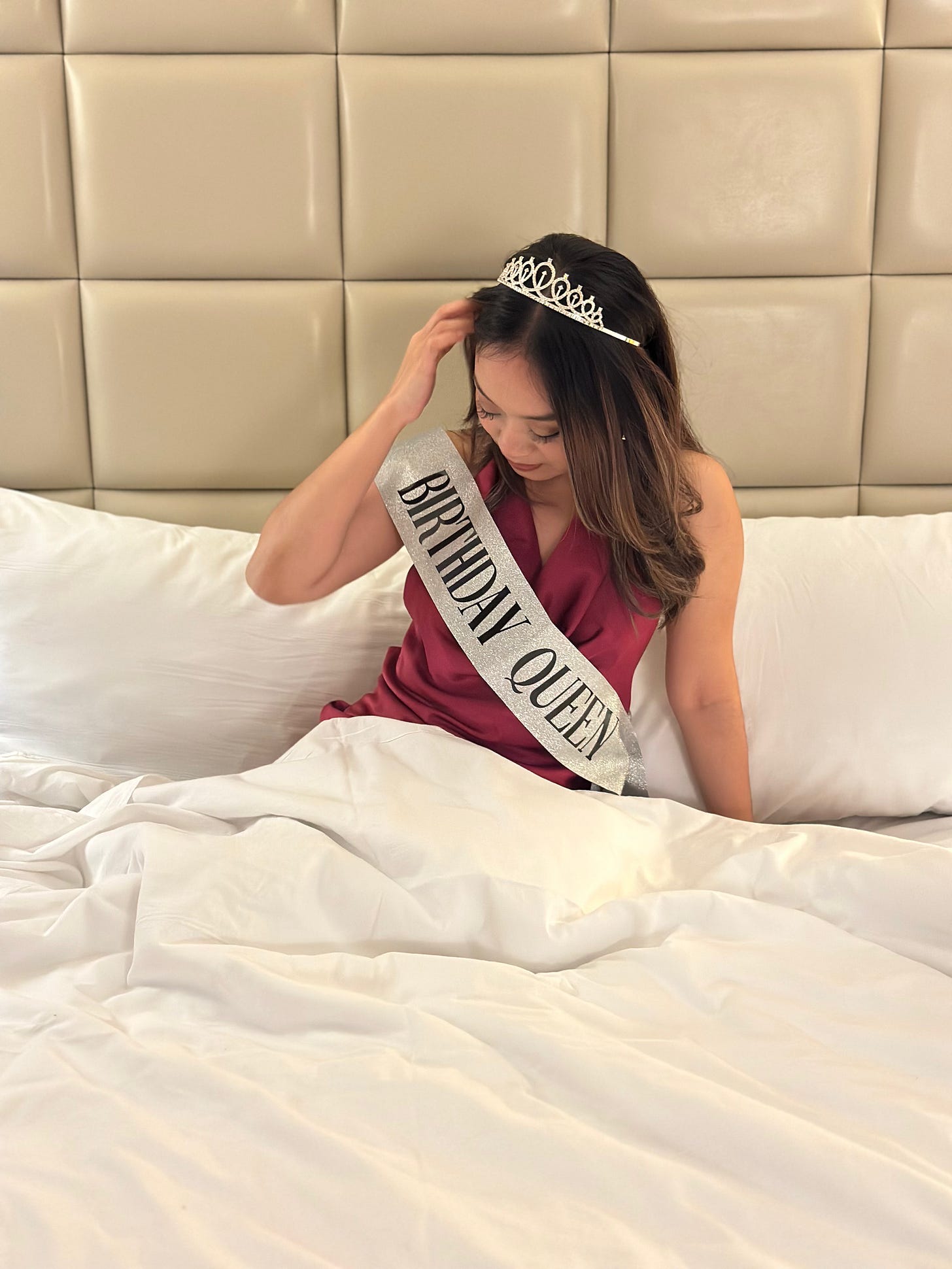
Turned 32 in Vegas! I know that hearing someone respond to your struggles in a way that you didn’t need can feel more demoralizing than simply being met with silence. In fact, sometimes that’s the exact tonic someone needs: room to just be, plus a tender, listening ear.
Something I’ve learned from being steeped in the world of self-help: I know that there’s a very fine line between the attempt to simplify and being simplistic. It’s tempting to believe that some quippy generalization (“iF hE wAntEd t0, hE w0uLd!!”) or theory (LeT tHeM!) can neatly explain our dilemmas or teach us how to handle life. And I’m not saying these can’t ever be helpful or true! But I’ve found both relief and mercy in remembering that there’s no one-size-fits-all response to life. We’re all messy, layered, less-than-rational beings, living intricate and idiosyncratic personal lives. Embracing that makes it much easier to practice kindness and curiosity — towards ourselves and others.
I know that I now appreciate softer, more nuanced takes than hot, digestible ones. The thought leaders I consider trustworthy are those who show rigor and balance in their opinions. They don’t make their case through utter conviction or charisma — nowadays, these people can make me feel as if they’re strong-arming me into their beliefs — but by demonstrating that an informed opinion is informed by different perspectives. And acknowledging that makes their point of view stronger, not weaker.
The test of a first-rate intelligence is the ability to hold two opposed ideas in the mind at the same time, and still retain the ability to function. — F. Scott Fitzgerald
I know that there’s a line where constantly resorting to toughness or even stoicism turns into insensitivity. Being unfeeling feels self-preserving, but it can be very alienating. It’s hard-heartedness masquerding as strength. Today I no longer believe that softness is a weakness, or that showing no frailty or self-doubt or vulnerability equates to strength. I believe that the strongest people push themselves to face, feel, and share their emotions. That is hard, brave work.
I know that our judgment of others can sometimes reveal something about ourselves. Usually, this is when the sentiment or source feels hard to articulate. A personal example: I used to balk at others for being “too much” or different, wondering how they could exist so loudly. I have since understood that that was envy. Because, deep inside, I, too, have always struggled to take up more space.
“Use your advantages, Ate”, a cousin recently told me. I can’t remember what we were talking about, but since then I’ve been seeing it everywhere: the people who have a sharp knowledge of what they already have, and learned to lean into that to make their dreams come true. Now I know that a sizeable part of success comes down to how well you harness your unique set of advantages. There’s no point in being apologetic about it (not to say that parading your privileges is a better option ehemnepobabycontentcreatorsehem ehemrichtokehem). But also: this isn’t just about money. Advantages certainly accrue from having wealth, but they can come from other places, too: the connections you make, the skills you’ve cultivated, your unique basket of experiences, or your natural affinities or eccentricities. I mean, if there’s anything to take away from the creator economy, it’s that, these days, personality can pay the bills — and a hell of a lot more.
I know that life sends us more grief than we care to acknowledge. We face the death of so many things: loved ones, relationships, the form of our relationships, almost-relationships, dreams both executed and expired, lifestyles, homes, doors, windows, ideas about ourselves and others and the world. Knowing this doesn’t make things easier, but it’s taught me to recognize my own claw marks, honor the heaviness, treasure what was, and treat myself with compassion.
I sat with my anger long enough, until she told me her real name was grief. - C.S. Lewis
I know that hobbies — and I mean activities done with zero expectation of profit — are important because they unlock a part of you that monetized ventures can’t.
Apart from Pure Hobbies, another thing I highly recommend: startup experience. Because I know that startup experience — or any opportunity to build something from the ground up — will rewire and humble you in a way that more structured places can’t.
I know that starting anything new almost always requires some degree of imitation — not because we’re not capable of originality, but because imitation is part of experimentation. And experimentation is an inevitable phase of learning.
I know that feedback is rocket fuel for progress. If you want to improve at something or help your work reach its best form, stop working on it in isolation. Expose your work and your process to others, ideally to a more trained eye.
I know that fixating on self-improvement chips away at our appreciation of the present. This occurred to me when I was rereading my journal entries from last year, where I, unconsciously, mostly yapped about the self I wanted to be (future) and the self I wanted to overcome (past). I found my then-self very annoying, like I just wanted her to shut up and tell me how her day went. What did she do? What did she notice? What did she celebrate about her life, if she celebrated at all?
I know that one of my greatest life hacks is having friends considerably older than me. Nothing is more affirming than people who’ve had more mileage in life and have lost all their fucks to give, telling you not to take things too seriously, because one day your fuck-ups will be nothing but a distant memory, that situationship, you’ll realize, was actually good for nothing, and you’ll look at all the things you wanted and realize that you no longer do. So don’t sweat it, roll with the punches, embrace your seasons, que sera sera!
I know that my life is exponentially better when I write — and I don’t just mean being a Writer. When I write down my to-do list, I’m more likely to follow through. When I take notes, I don’t have to be at the mercy of my finite and faulty memory. When I journal, I feel my thoughts and feelings have a lot less hold on me. When I write letters, I feel more connected to my loved ones and remember just how abundant my life is.
I know that creating distance is often a reliable next step when you feel lost or stuck, whether in a project, a relationship, or in life. It’s one of my favorite life & writing lessons: Whenever I can’t put my finger on what’s wrong or missing in a draft, I can usually trust that the answer will come after stepping away from it. Sometimes you really just have to walk away for a while. Let time and space refresh your eyes and reveal the gaps.
Sam Altman once said, “Almost everyone starts off extrinsically motivated to some degree.” I know this to be true for myself. I started dancing because I badly wanted to be like the cool dancers in our school. Growing up, I forced interest in reading because my smartest classmates always had a book in hand. I wanna tell you that I decided to take writing seriously five years ago because I wanted to touch people’s lives, but the truth is, I just hoped it would make me more marketable and impressive at work. What’s amazing about being human, though, is that our intentions aren’t static. They can mature over time, deepen the more we apply ourselves to the practice. It’s not too far from the way one experiences love: you crush on someone because you think they’re cute. But as you spend more time with them, you realize they’re so much more than their looks — and, oh, how much richer your life is because they’re part of it.
I know that I will always thank myself for giving myself a chance and committing to that chance.
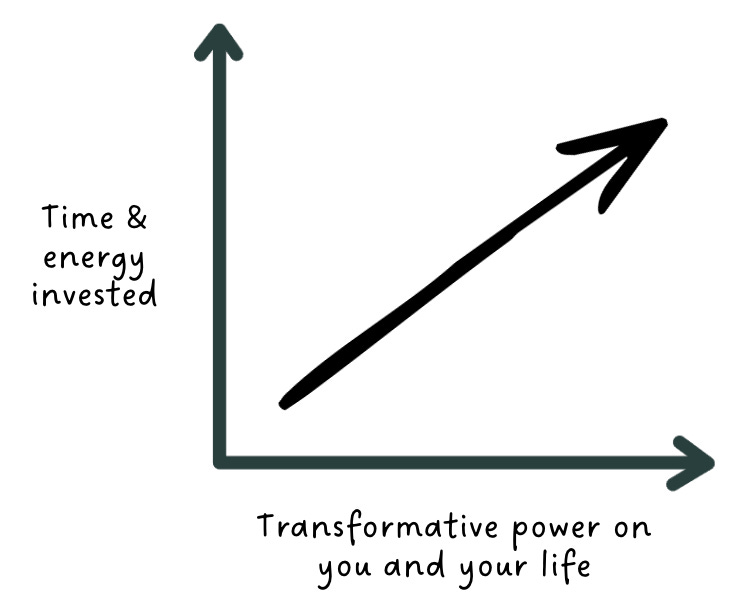
That said, from twelve years of dancing, six years of writing, and three years of being a fur mom, I know that the more time and energy you invest in something, the more transformative it will be.
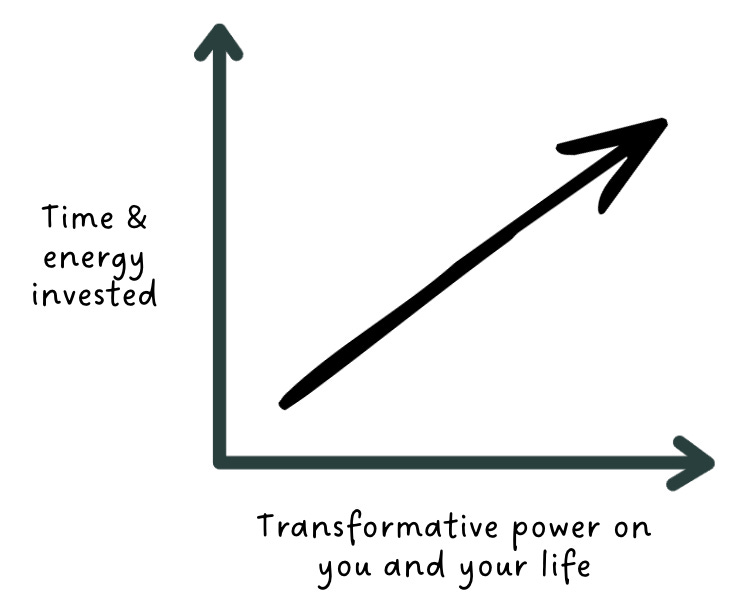
#24 in a diagram I know that biting more than you can chew can not only hurt you, but also the people around you. Presence, attention, and intention require energy. And when you’re always operating on a drained battery, it will be difficult for you to show up for those who need you in the way they need you to.
I know not to underestimate micro-transgressions. Small stressors can chip away at your health and well-being until one day you wake up feeling like a shell of yourself. Casual jibes from your colleagues can creep into your head and gradually erode your self-esteem. Watch your tired partner fall asleep yet again as you rant about your toxic boss, then the next day, you’re bursting into tears from feeling neglected in your relationship.
I tried keto for four months. It’s effective. But now I know that life is too short to give up carbs. (No disrespect to those who practice keto! Personally, I just love my carb-y breakfasts, my sushi. I love being able to try anything on the menu.)
I know that self-care isn’t as sexy or expensive as it’s marketed to us. Paying bills on time, taking a walk, cleaning your room, putting your phone down, having adequate and quality sleep, standing up for your boundaries, asking for support when you need it, or generally being honest with what you need — these fundamentals are hardly glamorous. Yet getting them right often proves more than enough.
In this numbers-driven world, I know that what you gain in scale, you lose in intimacy. But since you can’t measure intimacy — its impact or its return — it’s easy to understate its worth and inflate the significance of scale.
Speaking of scale, I know that “legacy” is such a loaded, lofty word, but making your mark is really as simple as sharing what you know. That’s why I absolutely loved the recent BAFTA moment between Best Actor winner Robert Aramayo and his fellow nominee Ethan Hawke. In Aramayo’s acceptance speech, he mentioned the time Hawke came to his class at Juilliard and gave a life-changing talk about art. As Aramayo thanked him, Hawke told his seatmate, “That’s better than winning.”
I know that facts and objective information are more pliable than we think — something that’s become alarmingly clear to me after my advertising stint. It’s about how you work the angle, the language you use. Take these examples:
Fact: Fine lines start to branch out from our eyes as we age.
Are those “Crow’s Feet” or “Laugh Lines”?
Fact: A market shows low volume/demand in a category.
Does it have “low potential” or does it have “headroom for growth?”
Fact: 25% of employees report that they’re unhappy at work.
Or is is that only 1 out of 4 employees is unhappy?
I know that the concept of a personal brand satisfies our brain’s propensity for predictability, consistency, and coherence. But being human — all weird and messy and multidimensional — is infinitely more interesting.
This format was lifted from Mari Andrew’s newsletter post “100 Things I Know.”

Congrats on making it all the way to the end! JSYK, I will be publishing more sporadically as I acclimate to a 9-to-5-less way of life and focus on other things. Frankly, I earn nothing from writing this newsletter — and yet, the returns have been tenfold. Thank you so much for being part of it.
I’ll be exploring more short-form writing, likely on Instagram. Follow along if you’re so inclined!
Catch you in your inbox on some surprise Sunday!